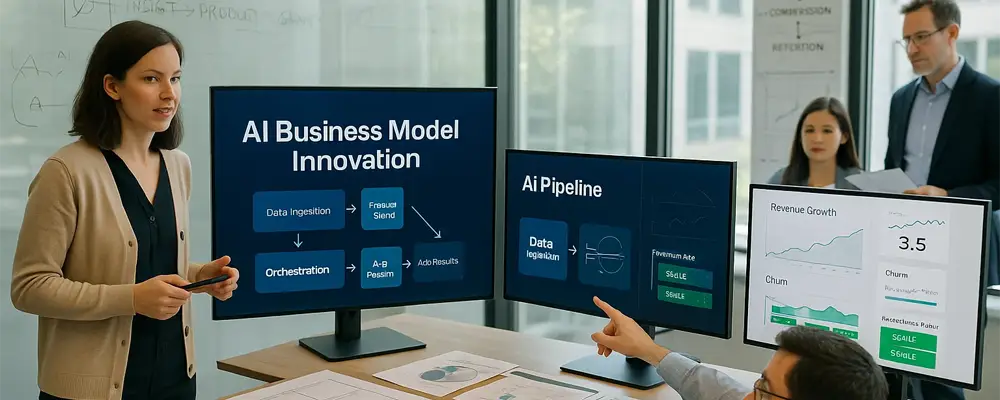
AI Business Model Innovation: How to Leverage AI for Business Innovation and Disruptive Growth
Estimated reading time: 12 minutes
Key Takeaways
- AI business model innovation is a strategic necessity for businesses to compete by enhancing efficiency, personalizing offerings, and creating new revenue streams.
- The core pillars of this transformation are redesigning value propositions, implementing an “AI Factory” framework for data and automation, and fostering cross-functional, AI-empowered teams.
- Future growth will be driven by generative AI, autonomous systems, hyper-personalization at a massive scale, and new monetization strategies like outcome-based pricing.
- Successful execution requires a clear strategic plan, starting with small pilot projects, embracing agile methods, and focusing heavily on change management and ethical governance.
Table of Contents
- The Driving Force: Why AI for Business Innovation is a Modern Imperative
- The Core Pillars: Foundations of AI Business Model Innovation
- The Next Frontier: Envisioning the Future of Business Models with AI
- From Vision to Action: A Guide to AI Strategic Planning
- Game Changers: Real-World Examples of Disruptive AI Business Models
- Making It Happen: From Strategy to Execution
- Your Next Move: Driving Competitive Advantage with AI Business Model Innovation
- Frequently Asked Questions
Hey there, colleague. Imagine this: digital disruption isn’t some distant storm cloud anymore—it’s the rain pouring down right now. Businesses everywhere are scrambling to stay dry, rethinking everything from how they operate to how they make money. That’s where AI business model innovation comes in.
Simply put, AI business model innovation is about strategically transforming how companies create, deliver, and capture value by weaving artificial intelligence deep into their core operations, offerings, and customer relationships.
As market pressures ramp up—think fiercer competition and customers demanding more—those embracing AI business model innovation aren’t just surviving; they’re thriving with new efficiencies, super-personalized experiences, and fresh revenue streams. Curious about the future of business models AI? This post dives into why AI is essential for innovation, the key foundations to build on, exciting trends ahead, and a step-by-step guide to AI strategic planning and rolling out disruptive AI business models. Let’s get into it.
The Driving Force: Why AI for Business Innovation is a Modern Imperative
Picture your business as a ship in rough seas. Without the right tools, you’re at the mercy of the waves. That’s why AI for business innovation isn’t optional—it’s a must. It directly tackles two big market forces shaking things up.
First, customers aren’t patient anymore. They want speed, ease, and experiences that feel made just for them. Old-school business models can’t keep up with that. Second, rivals using AI are zooming ahead. They work smarter, innovate quicker, and leave laggards in the dust.
But here’s the good part: jumping into AI for business innovation unlocks real wins. Start with enhanced operational efficiency. AI takes over boring, repetitive tasks—like chatbots handling customer queries or algorithms fine-tuning supply chains. This slashes costs and frees up your team for bigger ideas.
Then there’s deeply personalized offerings. Using AI analytics and recommendation engines, you can craft products, services, and ads that fit each customer like a glove. No more one-size-fits-all.
And don’t forget superior data-driven decision-making. Instead of reacting to problems after they hit, AI gives you predictive insights. Spot market trends early, guess customer moves, and steer your strategy proactively. It’s like having a crystal ball powered by data.
Mini Case Study: Netflix: AI-Powered Retention
Netflix nails AI for business innovation with its recommendation engine. By crunching viewing habits, it suggests shows and movies that keep users hooked. This boosts engagement big time and helps retain subscribers in a cutthroat streaming world. Without it, they’d lose ground fast.
All this isn’t theory—it’s proven. Businesses ignoring AI for business innovation risk falling behind, while those adopting it—like using machine learning for smarter operations—gain a real edge.
The Core Pillars: Foundations of AI Business Model Innovation
Okay, let’s build this from the ground up. Successful AI business model innovation means redesigning what value your company offers and how it runs. It’s not about slapping AI on top—it’s a full rethink. Think of it as renovating your house to make it smarter and more efficient.
First pillar: redesigning value and revenue streams. Move away from one-time sales to ongoing value. AI makes this possible with models like Product-as-a-Service (PaaS). Customers subscribe to outcomes, not just products—think software that updates itself or services that adapt to needs. This leads to hyper-personalized offerings that evolve, building loyal relationships and steady income. No more chasing one-off deals; it’s about lasting bonds.
Second pillar: adopting the “AI Factory” framework. This is a clever way to think about AI implementation. It’s like turning your business into a smart factory. Key parts include continuous data pipelines that keep feeding fresh info, automated decision engines that crunch data for predictions, and closed feedback loops where outcomes train the AI to get even better. Imagine it as a cycle: data in, smart choices out, lessons learned, repeat. This setup powers everything from intelligent automation to predictive analytics.
Third pillar: building cross-functional teams and empowering AI champions. Tech alone won’t cut it—people make it work. You need business leaders, data scientists, and ops experts collaborating. Enter the AI champion: a key player who sells the vision, breaks down resistance, and pushes execution across teams. It’s about changing culture, not just code.
These pillars aren’t isolated; they interconnect. For instance, your AI factory might feed data into hyper-personalized services, all driven by a strong team. Start here, and you’re set for real transformation—whether it’s robotic process automation streamlining workflows or machine learning uncovering new opportunities.
The Next Frontier: Envisioning the Future of Business Models with AI
What’s got me excited? The future of business models AI isn’t just tweaks—it’s whole new worlds. We’re talking about AI reshaping how businesses operate, creating opportunities that feel like science fiction but are happening now. Let’s peek ahead.
- Trend one: generative AI and autonomous systems. Generative AI creates stuff from scratch—like custom designs, code, or content—with almost no extra cost. It’s a game-changer for innovation. Then autonomous systems, such as self-driving trucks or robot-run factories, slash labor needs and rewrite cost structures. Picture factories humming along without breaks, all thanks to intelligent machines.
- Trend two: hyper-personalization at scale. AI lets you tailor everything in real-time for millions. Dynamic pricing adjusts on the fly, customer journeys adapt to behaviors, and content gets individualized. It’s not mass marketing; it’s one-to-one, powered by data analytics and machine learning.
- Trend three: new AI-driven monetization scenarios. We’re seeing subscription-as-a-service expand beyond apps to physical goods and results. Outcome-based models mean customers pay for success—like boosted factory output, not the tech itself. And ecosystem orchestration? Your AI platform becomes the industry’s nerve center, connecting players for mutual wins.
Let’s make it real with industries. In healthcare, AI enables predictive medicine and spot-on diagnostics, catching issues early. Finance gets robo-advisors for personalized investments, democratizing wealth management. Retail thrives on intelligent recommendation engines and predictive inventory, cutting waste and boosting sales.
The future of business models AI is about blending these trends—think generative tools in autonomous setups for hyper-personalized ecosystems. It’s disruptive, sure, but oh-so-rewarding if you jump in thoughtfully.
From Vision to Action: A Guide to AI Strategic Planning
Ideas are great, but execution? That’s where winners emerge. This is your bridge to making AI strategic planning real—turning big thoughts into steps that drive model innovation. Let’s break it down simply, like mapping a road trip.
- Step one: set a clear vision and define your archetype. Don’t start with gadgets; focus on business outcomes. What do you want? Pick an archetype: Enhancer (boost your current setup), Adapter (borrow proven AI ideas), Reinventor (build a fresh core model), or Orchestrator (create an AI ecosystem). This sets your ambition and keeps everyone aligned.
- Step two: conduct a capability assessment. Look honestly at where you stand. Check gaps in technology (do you have the right tools?), data readiness (is your info clean and accessible?), and talent (got the skills onboard?). It’s like a health check-up for your business’s AI potential.
- Step three: develop a phased roadmap. Make it practical with milestones. Include quick wins—small projects that show fast results and build excitement. Then outline long-term goals, like scaling to full intelligent automation.
- Step four: establish governance and ethical guidelines. AI isn’t wild west; manage risks. Watch for algorithmic bias, protect data privacy, and keep things transparent. This builds trust and avoids pitfalls, ensuring your AI strategic planning is sustainable.
- Step five: align with corporate strategy and KPIs. Tie it all to your big-picture goals. Use measurable KPIs—like efficiency gains or revenue from new streams—to track progress. Prove the value, adjust as needed.
Throughout, weave in related ideas like machine learning integration or data-driven strategies. AI strategic planning isn’t a one-off; it’s ongoing, adapting to changes. Follow this, and you’re not just planning—you’re innovating.
Game Changers: Real-World Examples of Disruptive AI Business Models
Disruptive AI business models? They’re the ones flipping industries on their heads, using AI for advantages others can’t match. These aren’t tweaks—they redefine competition. Let’s look at patterns and examples that show it’s already happening.
- Pattern one: AI-powered platform monopolies. Think ride-sharing apps. They use AI to match drivers and riders perfectly, scaling huge without owning cars. It’s efficient, fast, and dominates markets by leveraging network effects and predictive algorithms.
- Pattern two: the power of data network effects. Here’s the magic: more users mean more data, smarter AI, better service, which pulls in even more users. It’s a loop that builds an unbeatable moat. Companies mastering this—through continuous learning and big data—lock in loyalty.
- Pattern three: the rise of AI-native startups. These are built with AI at the heart. Take a digital lender: AI scores credit risks instantly, ditching slow bank paperwork. It’s quicker, cheaper, and opens doors for underserved customers.
Revisit sectors for concreteness. In finance, robo-advisors like Betterment offer tailored advice at low cost. Healthcare sees AI diagnostic tools speeding up accurate reads on scans. Retail? Amazon’s engines recommend products and manage stock predictively, turning browsing into buying.
Key lessons from these disruptive AI business models: scale needs strong partnerships, top talent in areas like machine learning, and solid change management to handle shifts. It’s not easy, but the rewards? Massive, like creating entirely new value chains.
Making It Happen: From Strategy to Execution
You’ve got the plan—now roll up your sleeves. Turning strategy into execution is where AI business model innovation really shines. It’s hands-on, iterative, and yes, a bit messy, but that’s how progress happens. Let’s walk through the steps.
- Step one: start with pilot projects. Skip the massive overhaul; test small. Pick a targeted area—like automating a workflow with AI—and run it. This uncovers issues fast, delivers quick learnings, and proves value to doubters. It’s like dipping a toe before diving in.
- Step two: embrace agile sprints. Work in short bursts: build, test, refine. This keeps things flexible, letting you pivot based on real feedback. Think of it as evolving your model through machine learning-style iterations.
- Step three: build continuous learning loops. Set up systems for ongoing feedback. Ensure data flows freely so AI improves over time. Post-launch, it’s not “done”—it’s adapting, much like predictive analytics refining predictions.
- Step four: prioritize change management. Tech is half the battle; people are the rest. Get buy-in from stakeholders, train your team to work alongside AI (upskilling in data literacy, say), and make sure data is high-quality and easy to access. Without this, even the best plans flop.
- Step five: measure ROI and iterate. Track everything against KPIs—cost savings, new revenue, efficiency boosts. Use insights to tweak your model and scale winners. It’s data-driven decisions in action.
Execution ties back to foundations: your AI factory powers pilots, teams drive sprints. Add in ethical checks, and you’re building sustainable, disruptive growth. Witty aside: if strategy is the map, execution is the engine—don’t leave home without both.
Your Next Move: Driving Competitive Advantage with AI Business Model Innovation
Wrapping this up, friend: AI business model innovation is your ticket to not just keeping up, but leading in a world of endless change. By embedding AI deeply, you’re unlocking efficiencies, personal touches, and revenue paths that traditional models miss. It’s the edge for disruptive growth and the future of business models AI.
Ready to act? Here’s your playbook:
- Conduct an AI Readiness Audit: Evaluate your tech, data, and talent today. Spot gaps and strengths.
- Engage Stakeholders: Gather a cross-functional team for AI strategic planning. Brainstorm and align on visions.
- Prototype Your First Model: Pick a small idea, test it, learn quick, and scale successes.
Dive deeper with whitepapers, AI tools online, and expert communities. They’re goldmines for refining your approach.
Frequently Asked Questions
What exactly is AI business model innovation?
It’s the process of fundamentally changing how a business creates, delivers, and captures value by integrating artificial intelligence into its core strategy. This goes beyond simple automation to include new services, revenue models, and customer experiences.
What is the “AI Factory” framework?
The “AI Factory” is a conceptual framework where a business systematically operationalizes AI. It involves creating continuous data pipelines, using automated engines for decision-making, and establishing feedback loops where the results of those decisions are used to improve the AI models over time.
How can a small business start with AI innovation?
Start small with a pilot project. Identify a specific, high-impact problem that AI can solve, such as automating customer service responses or analyzing sales data for insights. A successful pilot can prove ROI and build momentum for larger initiatives.
What are the biggest risks in implementing AI for business models?
The primary risks include poor data quality, lack of in-house talent, ethical concerns like algorithmic bias, data privacy issues, and a failure to manage the cultural shift required for employees to work with AI. Strong governance and a focus on change management are essential to mitigate these risks.