How to Master MVP Development for Startups: A Step-by-Step Guide
Estimated reading time: 11 minutes
Key Takeaways
- An MVP is a basic, functional version of a product used to attract early users and validate an idea with minimal investment.
- It is a core component of the startup lean methodology, which follows a cycle of build, measure, and learn to reduce waste.
- The primary goal of an MVP is to test market assumptions, gather user feedback, and find product-market fit before scaling.
- Key stages include idea validation, customer discovery, prototyping, development, and user testing.
Table of Contents
Imagine you’re a startup founder with a brilliant idea that could change the game. But your budget is tight, time is short, and you’re not sure if anyone will actually want what you’re building. Sound familiar? That’s the classic startup puzzle. The good news? Mastering MVP development for startups is your way out. It lets you test the waters without sinking the ship.
So, what exactly is a minimum viable product? Think of it as a basic version of your idea—functional enough to attract early users and prove whether it’s worth pursuing. It’s not about perfection; it’s about getting something out there to learn from real people. This approach, tied to the startup lean methodology, helps you save cash and spot issues early.
Why bother? An MVP tests your big assumptions about the market, collects honest feedback, and tweaks your business plan before you go all-in. It’s all about smart risks. Rooted in idea validation and customer discovery, it guides you through prototyping, user testing, and finally hitting that sweet product-market fit.
In this guide, we’ll walk you through each step. You’ll see how to turn your concept into something users love, with real-world tips and no wasted words. Ready to dive in? Let’s get your startup moving.
1. Embracing the Startup Lean Methodology as Your North Star
Ever wonder why some startups skyrocket while others crash? It’s often about their guiding philosophy. Enter the startup lean methodology—it’s like a compass for building smart, not just fast.
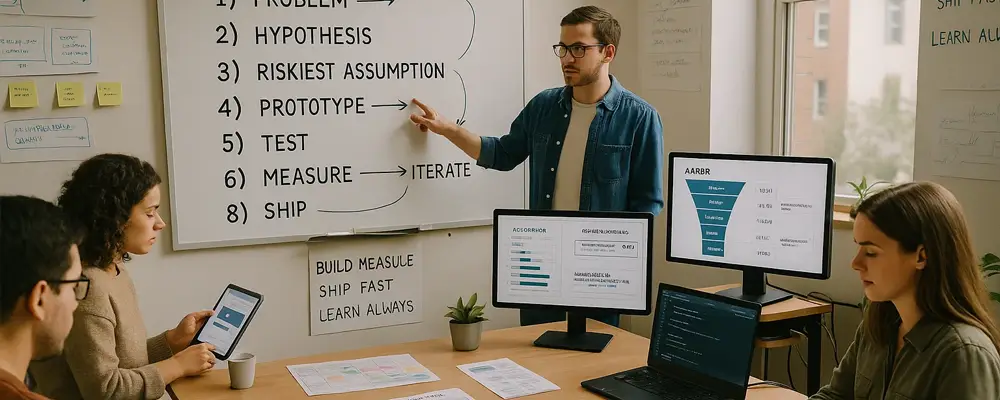
At its heart, this method cuts out waste and amps up learning. It’s built on a simple loop: build, measure, learn. You create a rough version of your idea, see how people use it, and then adjust based on what you find out.
Let’s break it down. First, build: Whip up a minimum viable product to test your main guess about what users need. Keep it basic—just the essentials.
Next, measure: Put it in users’ hands and watch closely. Track how they interact, what they like, and where they get stuck. Use tools for data and chats for stories.
Then, learn: Dig into that info. What surprised you? This step decides if you tweak, pivot, or double down.
This isn’t about skimping on quality. It’s the core of MVP development. By cycling through this quickly, you get feedback fast, spot flaws early, and steer toward product-market fit without burning through your funds.
“Think of it as startup judo—using small moves for big wins. Lean thinking turns assumptions into facts, making your whole process more like a conversation with the market.”
Curious how this fits with real builds? It powers everything from app launches to service tweaks, always focusing on validated learning over guesswork.
Synonyms like “agile startup approach” or “efficient innovation cycle” pop up here, but it’s all about that lean core. Related terms? Things like iterative development and feedback loops keep it contextual.
2. Idea Validation: Ensuring You’re Solving a Real Problem
Before you code a single line, ask: Is this idea even worth it? Idea validation is your first defense. It’s quick, cheap, and can save you from building a flop.
Picture this: You think you’ve got a killer app for busy parents. But do they? Validation answers that by testing demand without a full product.
- Start with a landing page. Make a simple site that explains your idea and asks folks to sign up or learn more. If they bite, great—interest is there.
- Take it up a notch with a smoke test. Add a “buy now” button that leads to a “coming soon” note. This checks if people would actually pay, not just browse.
- Surveys are gold too. Send them to your target crowd. Ask about their daily hassles and if your fix sounds appealing. Keep questions open to get honest vibes.
Make it like science. Form a hypothesis: “We think dog owners need an auto-feeding gadget. We’ll know if 100 sign up in a month.” This focus on hypothesis formulation is key.
Set metrics to watch. Look at sign-up numbers, click rates, and survey scores. These hard facts and demand metrics show if the market cares.
Tying back to startup lean methodology, this step embodies efficiency. It’s about proving need early, so you don’t waste effort on duds.
Ever seen a startup pivot after validation? It’s common—and smart. This process de-risks your path, focusing on real problems.
Words like “concept testing” or “market check” fit here, with LSI terms such as hypothesis formulation and demand metrics adding depth.
3. Customer Discovery: Learning Directly from Your Target Audience
You can’t build in a bubble. Customer discovery gets you out talking to real people. It’s like detective work—uncovering what users truly need.
“The key mantra? Get out of the building. Don’t assume; ask and observe. This digs into their world, spotting pains you might miss.”
Kick off with problem interviews. Chat with potential users without selling. Ask: What’s bugging you? How do you handle it now? What hurts most?
Go further with observational research. Watch them in action. See a chef juggling orders? That mismatch between what they say and do is pure insight.
From these chats, build customer personas. Create profiles like “Sarah, the freelance writer who hates admin tasks.” Include her goals, gripes, and habits.
These personas guide your MVP development. Use them to pick features that hit the biggest pains first. It’s not guesswork; it’s data-driven priority.
This step ensures your product solves real issues, boosting chances of traction. It’s thoughtful—almost curious—how one interview can flip your whole plan.
Think of it as building empathy. Synonyms? User research or audience insights. LSI buddies include pain point mapping and persona development.
4. Prototyping: Turning Concepts into Tangible Models
Ideas are fuzzy until you make them real. Prototyping bridges that gap, creating mockups for early checks before the big build.
It’s your testable model—not the final thing, but close enough to spot issues. This ties straight into user testing, validating flows without code commits.
- Start low-fidelity. Grab paper and sketch screens or flows. It’s fast and cheap, perfect for big-picture ideas like app navigation.
- Move to high-fidelity for detail. Use tools to make clickable versions that feel real. Test buttons, menus, and looks to catch usability snags.
Tools? Pen and paper work, but try Figma or Balsamiq for digital ease. Anyone can do this—no design degree needed.
The win? You fix problems early, cutting rework in MVP development. It’s like a rehearsal before the show.
Wit here: Prototypes are your “what if” playground. Synonyms: Mockup creation or concept modeling. LSI: Wireframing, interaction design.
5. MVP Development: Building Your Minimum Viable Product
Now, the build. MVP development isn’t about half-baked stuff—it’s strategic, focusing on what matters to users.
Key: Nail the scope. “Minimum” means just the core that works. “Viable” means it delivers real value, solving the main problem.
Sort features. Must-haves? Those tied to customer discovery pains. Nice-to-haves? Save for later versions. Important LSI terms here include feature prioritization.
Go agile. Use methods like Scrum for short sprints. Build a bit, test, repeat. This keeps things flexible, adapting to new insights.
Your roadmap? Base it on validated needs from earlier steps. No rigid plans—stay nimble.
This process turns concepts into something shippable, learning as you go.
It’s thoughtful: Build with purpose, not haste.
Curious fact: Many hits started as simple MVPs. Synonyms: Core product build or initial launch version. LSI: Feature prioritization, sprint cycles.
6. User Testing: Gathering Actionable Feedback on Your MVP
You’ve built it—now test it. User testing closes the loop, revealing if your MVP hits the mark.
It’s the measure and learn bits of the cycle. Watch real users try it, then refine.
- Craft a test plan. Give tasks like “Book a ride in our app.” This checks if it’s intuitive, not just liked.
- Pick testers who match your customer discovery personas. Early adopters give the best, honest input.
- Gather data two ways. Qualitative: Observe and interview for “why” stories. Quantitative: Track metrics like success rates or time spent.
Every finding? Turn it into action for the next round. This sharpens your MVP development.
Thoughtful twist: Users surprise you—embrace it. Synonyms: Feedback sessions or usability checks. LSI: Analytics tracking, task analysis.
7. Iterating Toward Product-Market Fit
The endgame? Product-market fit. It’s when your offering clicks with the market, pulling in users naturally.
Spot it by signals: Users stick around, engage deeply, and spread the word. Ask: “How upset if this vanished?” “Very” means fit.
Get there via iteration. Use user testing insights to tweak, experiment, and improve.
Only scale after—add features, market more.
Premature growth flops without fit.
This is MVP development’s payoff: A product that thrives. Wit: It’s like dating—find the match before committing.
Synonyms: Market alignment or fit achievement. LSI: Retention metrics, growth indicators.
Conclusion & Your Next Steps
Wrapping up, MVP development for startups thrives on the startup lean methodology. It’s a loop of learning, not a straight shot.
You’ve seen the path: From idea validation and customer discovery to prototyping, user testing, and nailing product-market fit. Each step builds on the last, turning guesses into wins.
Ready to act? Here’s your checklist:
- Set a clear, testable hypothesis about your minimum viable product’s value.
- Schedule 5-10 customer interviews or launch a validation survey this week.
- Build a low-fidelity prototype of your core feature and get feedback.
- Launch your minimum viable product and run your first structured user test.
- Commit to iterating rapidly based on what you learn.
For guidance on pitching your MVP to investors, see our guide.
This approach isn’t magic—it’s proven. Dive in, iterate, and watch your startup soar. You’ve got this.
Frequently Asked Questions
What’s the difference between an MVP and a prototype?
A prototype is a mockup, often not functional, used to test design and user flow concepts. An MVP is a functional, shippable product with the minimum features needed to solve a core problem for early users and gather real-world data.
How “minimum” should an MVP be?
It should be “minimum” in features but “viable” in value. It must solve at least one key problem for the user effectively. It shouldn’t be buggy or incomplete; it should be a polished version of a very small feature set.
How long does it take to build an MVP?
This varies widely depending on complexity, but the goal is speed. A typical MVP development cycle aims for 2-4 months. The key is to get to the “measure” and “learn” stages as quickly as possible without sacrificing core viability.
What if my MVP fails to get traction?
That’s a good thing! An MVP “failure” is actually a success in learning. It means you’ve discovered that your initial hypothesis was wrong without wasting a huge budget. The next step is to use the feedback to “pivot” (change direction) or “persevere” (iterate on the idea).