Product-Led Growth for Startups: A Step-by-Step Guide
Estimated reading time: 7 minutes
Key Takeaways
- Product-led growth (PLG) for startups uses the product to drive acquisition, conversion, and retention, reducing reliance on traditional sales and marketing.
- This strategy significantly lowers customer acquisition costs (CAC) and accelerates scaling by creating a self-serve user experience.
- A successful PLG framework is built on a seamless user onboarding process, smart freemium models, and engineered viral loops.
- Product analytics are essential for tracking key metrics like activation, retention, and feature adoption to continuously optimize the user journey.
Table of Contents
- What is a PLG Strategy and Why is it Essential?
- Step 1: Crafting a Seamless User Onboarding Experience
- Step 2: Choosing and Optimizing Your Freemium Models
- Step 3: Mastering In-Product Conversion Optimization
- Step 4: Engineering Viral Loops for Organic Growth
- Step 5: Implementing Robust Product Analytics
- Step 6: Driving Ongoing Feature Adoption
- Step 7: Measuring and Improving Key User Engagement Metrics
- Conclusion and Next Steps
- Frequently Asked Questions (FAQ)
Hey there, fellow startup builder. Ever feel like you’re pouring cash into ads and sales calls, only to watch growth crawl along? Customer acquisition costs skyrocketing, and standing out in a crowded market seems impossible. What if your product could sell itself? That’s the magic of product-led growth for startups—a game-changer where your product drives the show.
Product-led growth for startups flips the script. Instead of heavy sales and marketing, your product becomes the star for attracting, keeping, and monetizing users. It’s a PLG strategy that slashes costs and speeds up scaling. Think of it as letting users experience value firsthand, turning them into advocates without a pitch.
Why does this fit startups so well? It sparks quick organic adoption, cuts operational overhead, and lets you iterate fast based on real user behavior. Your product is easy to try, intuitive to use, and shareable, fueling growth from the inside out.
In this guide, we’ll walk through the essentials. You’ll get the lowdown on building a solid PLG strategy, nailing user onboarding, picking freemium models, optimizing conversions, creating viral loops, using product analytics, boosting feature adoption, and tracking user engagement metrics. Let’s dive in and make your startup’s growth unstoppable.
What is a PLG Strategy and Why is it Essential?
Picture this: You’re running a startup, and instead of chasing leads, users flock to you because your product just clicks. That’s the heart of a PLG strategy—a business approach where the product itself handles user acquisition, expansion, conversion, and retention. No more relying on sales reps or big ad spends; the product does the heavy lifting.
In simple terms, a PLG strategy means your product is the main vehicle for acquiring, activating, and retaining users. It’s all about creating a seamless experience that pulls people in and keeps them hooked.
For startups, this is gold. Let’s break down the big wins.
- Lower Acquisition Costs: Users find your product, sign up, and dive in without a salesperson involved. This self-serve setup slashes customer acquisition costs (CAC) by ditching pricey teams and funnels.
- Faster Feedback Loops: With users jumping straight into the product, you get raw insights quick. Spot what’s working (or not) and tweak on the fly—it’s like having a constant focus group.
- Viral Scalability: Happy users spread the word naturally, creating viral loops that snowball growth. No need for massive marketing budgets; word-of-mouth does the job.
But here’s the key: A PLG strategy isn’t just for the product team. It demands everyone—from engineering to sales—aligns around user success. This shift builds a culture obsessed with delivering value through the product, making your whole company more agile and user-focused.
Curious how this plays out? Startups using PLG often see exponential growth because it’s scalable and efficient. Synonyms like product-driven growth or user-centric scaling highlight the same idea: Let the product lead, and the rest follows.
Think of LSI terms like growth hacking through product experience or self-sustaining user expansion. It’s not magic; it’s methodical.
Step 1: Crafting a Seamless User Onboarding Experience
Okay, you’ve got users at your door. Now what? User onboarding is your chance to wow them in the first five minutes. It’s about guiding them to that “aha!” moment—where they see real value—super fast. Mess this up, and they’ll bounce.
The goal? Make onboarding feel effortless, like chatting with a friend who’s showing you the ropes. Focus on principles that reduce hurdles and build excitement.
- Minimal Friction: Keep sign-up dead simple. Use social logins or just an email—no endless forms. Why? Users want in quick, without the hassle.
- Welcome Screen: Hit them with a friendly greet and point out one or two key actions. “Hey, try this feature first to see results!” It sets the stage without overwhelming.
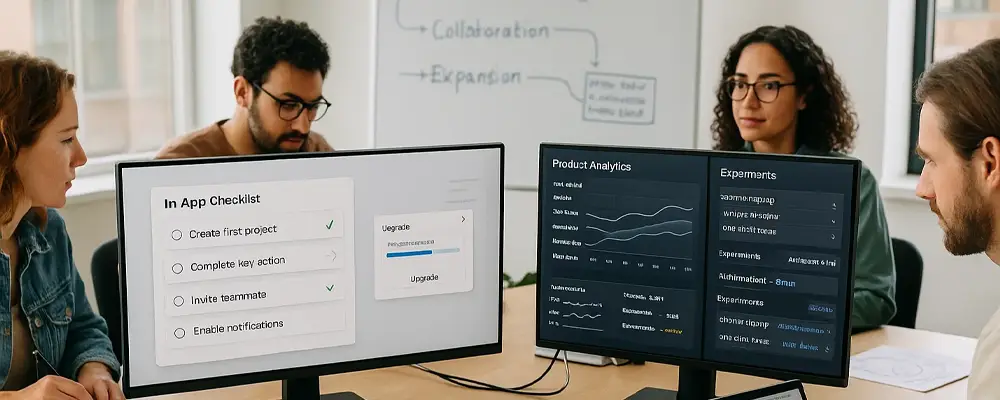
- Interactive Guidance: Skip boring videos. Go for hands-on walkthroughs, like clickable checklists or tooltips that pop up as they explore. It’s engaging and lets them learn by doing.
This ties into self-service SaaS, where users expect to navigate on their own. Think empowering them with in-app hints, tutorials, or progress trackers. No hand-holding needed—just smart nudges.
A big piece is time-to-value (TTV)—how long until a user feels the win. Shorten it by spotlighting your killer feature right away and cutting fluff. For example, if your app automates tasks, get them automating in under a minute.
In PLG, this onboarding is crucial for self-service models. Synonyms like smooth user initiation or effortless entry point emphasize getting users hooked fast. LSI terms? Consider onboarding flows, activation journeys, or user activation strategies— all about that quick path to delight.
Done right, it turns curious visitors into loyal fans. Ever wonder why apps like Slack feel so intuitive? It’s this kind of thoughtful design.
Step 2: Choosing and Optimizing Your Freemium Models
Freemium models are a PLG powerhouse. You offer part of your product for free, drawing in tons of users who then upgrade for more. It’s like giving a free sample that hooks them on the full flavor.
But picking the right model matters. Let’s explore types that work for startups.
- Feature-Gated: Free users get basics, but pay to unlock advanced tools. Slack does this with limited message history—enough to start, but pros need more.
- Usage-Gated: Limit how much they can do for free, like Dropbox capping storage. It lets light users stay free while heavy ones pay up.
- Limited Free Trial: Full access for a short time, say 14 days. Perfect for showing everything, then converting based on that taste.
The trick? Balance. Your free tier must deliver real value to spark sharing and retention, but leave enough out to motivate upgrades. Too generous, and nobody pays; too stingy, and they leave.
Watch for free-rider syndrome—users maxing out free without upgrading. Spot them with data, then nudge gently. Use in-app messages like, “Unlock unlimited with premium—here’s what you’re missing.” This boosts conversion optimization.
Synonyms for freemium include free-to-paid models or tiered access strategies. LSI keywords? Think pricing tiers, upgrade paths, or monetization gateways. It’s all about sustainable growth through smart limits.
Freemium isn’t a “free lunch”—it’s a clever trapdoor to paid bliss.
Step 3: Mastering In-Product Conversion Optimization
In PLG, conversions happen inside the product—no sales calls required. Conversion optimization is about turning free users into paying ones through clever, in-app tactics. It’s your silent salesperson.
Focus on making upgrades feel natural and timely.
- Contextual Upgrade Prompts: When someone tries a locked feature, pop up a modal. Explain the value and offer a one-click upgrade. “Love this? Go premium now!“
- Trial Expiry Nudges: As a trial winds down, use banners or emails. Remind them of features they’ll lose, and extend for engaged users to seal the deal.
- A/B Testing: Test relentlessly. Tweak button colors, pricing copy, email timing, or feature teasers. Data shows what converts best.
Build trust with social proof. Show customer logos, quick testimonials, case studies, or ROI calculators on upgrade pages. It creates urgency: “See how others boosted ROI by 30%?“
This is core to PLG’s user-centric vibe. Synonyms like in-app monetization or upgrade funnel tweaks fit. LSI terms: Conversion funnels, user journey optimization, or behavioral triggers. Thoughtful, right? It’s like psychology meets product design.
Ever notice how Netflix nudges you seamlessly? That’s the wit of good optimization—subtle yet effective.
Step 4: Engineering Viral Loops for Organic Growth
Viral loops are the secret sauce for explosive growth. It’s a cycle where one user brings in another (or more), creating self-sustaining momentum. Aim for exponential spread, not just steady adds.
How? Design features that encourage sharing naturally.
- Referral Programs: Reward both sides, like “Give a friend a free month, get one yourself.” Dropbox nailed this with extra storage.
- Collaborative Features: Build in teamwork, as in Figma or Google Docs. The product gets better with friends, so invites happen organically.
- Shareable Content: Let users create and share with a branded link, like Canva’s “Made with Canva.” It turns creations into ads.
For success, use dual incentives—benefit the sharer and the invitee. Track the virality coefficient (k-factor): How many new users per existing one? Over 1 means boom time. Monitor and tweak.
This fuels organic expansion in PLG. Synonyms: Sharing cycles or referral engines. LSI: Growth multipliers, network effects, or invitation mechanics. Curious fact: One viral loop can outpace a whole marketing team.
Step 5: Implementing Robust Product Analytics
Product analytics is the brain of your PLG operation. It’s how you measure, understand, and improve everything. Without it, you’re flying blind—guessing what users love or hate.
Start by picking tools like Amplitude, Mixpanel, or Heap. They track events, funnels, and behaviors in real-time.
Key? Define metrics that matter.
- Activation Rate: Percent of users hitting that “aha” action, like completing a first task.
- Time-to-Value: Average time to first win. Shorter is better for retention.
- Feature Adoption: See which parts get used most. Focus on underperformers.
Build dashboards to visualize journeys. Spot drop-offs, like from signup to activation, and fix them fast.
This data-driven approach is PLG’s core. Synonyms: Usage insights or behavioral analytics. LSI: Event tracking, funnel analysis, or user metrics dashboards. It’s like having a crystal ball for your product.
Step 6: Driving Ongoing Feature Adoption
You’ve built cool features—now get users to actually use them. Feature adoption drives retention; it’s the glue that keeps people coming back.
First, use product analytics to ID must-haves (tied to long-term loyalty) vs. nice-to-haves. Prioritize pushing the essentials.
Tactics to ramp it up:
- Contextual Onboarding: Introduce features just-in-time, like a tooltip on first encounter. No info dumps.
- In-App Messaging: Announce updates with banners. Target non-users: “Haven’t tried automation? Here’s why you’ll love it.“
- Gamification: Add progress bars, badges, or rewards. It turns exploration into a fun habit.
This ongoing push is vital for PLG sustainability. Synonyms: Functionality uptake or capability integration. LSI: User habit formation, feature discovery, or engagement boosters. Witty note: Features are like hidden gems—make sure users find and polish them.
Step 7: Measuring and Improving Key User Engagement Metrics
User engagement metrics are PLG’s pulse. They show if users are sticking around and loving your product. High engagement means low churn and steady revenue.
Track these essentials:
- DAU/MAU Ratio: Daily active over monthly. Above 20% signals stickiness in SaaS.
- Session Length: How long users stay per visit. Longer means deeper value.
- Retention Curves: Graphs of return rates over time, by cohorts.
- Churn Rate: Percent who leave. Keep it low to maximize lifetime value.
Use cohort analysis—group users by signup date—to spot trends. Did a new feature boost retention? Calculate LTV accurately from this.
For laggards, re-engage:
- Targeted Emails: “Miss us? Check these new features.“
- Push Notifications: “Your dashboard update is live!“
- In-App Triggers: Welcome-back guides for returnees.
This keeps the engine humming. Synonyms: Interaction indicators or retention stats. LSI: Stickiness ratios, cohort tracking, or re-activation tactics. Thoughtful twist: Metrics aren’t just numbers—they’re stories of user love.
Conclusion and Next Steps
We’ve covered the full roadmap: From grasping a PLG strategy, to perfecting user onboarding, freemium models, conversion optimization, viral loops, product analytics, feature adoption, and user engagement metrics. It’s a step-by-step path to product-led growth for startups.
At its core, a well-executed PLG strategy lets startups grow faster, smarter, and cheaper by prioritizing user experience. It builds sustainable momentum through organic means.
Ready to act? Start small. Dive into your analytics, find the weakest link—maybe onboarding or retention—and fix it. Map your user journey today, pick one metric to boost this quarter, and watch product-led growth for startups transform your venture.
Frequently Asked Questions (FAQ)
1. What is the main difference between product-led and sales-led growth?
Product-led growth (PLG) uses the product itself as the primary driver for acquiring, converting, and retaining customers, often through a self-serve freemium or trial model. Sales-led growth relies on a sales team to interact with prospects, provide demos, and close deals, which is common for complex, high-ticket enterprise software.
2. Can any startup use a PLG model?
While PLG is incredibly powerful, it works best for products that are easy for users to adopt and understand without extensive training. Products with a quick time-to-value, natural collaborative features, and a large potential user base are ideal candidates. Highly complex or niche enterprise tools may still require a sales-led or hybrid approach.
3. What is the most important metric to track in a PLG strategy?
There’s no single “most important” metric, but Activation Rate is a critical starting point. It measures the percentage of new users who experience the product’s core value (the “aha!” moment). A low activation rate signals a problem with your onboarding or product value proposition, which will cripple all other growth efforts.
4. Do you need a sales team in a product-led company?
Not always at the beginning, but many successful PLG companies eventually add a sales team. Instead of cold calling, this team focuses on “product-qualified leads” (PQLs)—free users who show high engagement or hit usage limits. The sales team then helps these users upgrade to enterprise plans, assists with complex implementations, and expands accounts.