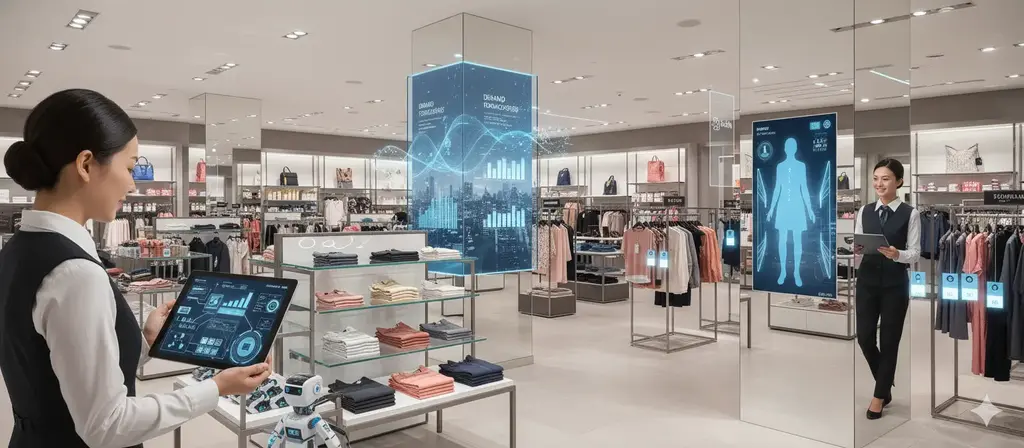
How AI in Retail is Transforming Inventory, Forecasting, and Personalization
Estimated reading time: 11 minutes
Key Takeaways
- AI Optimizes Inventory: Predictive analytics helps eliminate costly guesswork, reducing overstock and preventing stock-outs to maximize capital efficiency.
- AI Improves Forecasting: By analyzing a wide range of internal and external data, AI demand forecasting allows retailers to anticipate market shifts and stay ahead of trends.
- AI Drives Personalization: A retail personalization engine crafts unique 1:1 customer experiences, significantly boosting engagement, loyalty, and conversion rates.
- AI is a Competitive Necessity: Adopting AI solutions is no longer optional; it provides a transformative impact on sales and profits, separating market leaders from the competition.
Table of Contents
- Introduction
- The New Standard: Why AI for Ecommerce is No Longer Optional
- Eliminating Guesswork with Predictive Analytics for Inventory
- Staying Ahead of the Curve with AI Demand Forecasting
- The Foundation: Understanding Machine Learning in Retail
- Crafting 1:1 Experiences with a Retail Personalization Engine
- The Future of Retail is Intelligent
- Frequently Asked Questions
Introduction
Picture this: You’re a retail manager trying to compete with online giants like Amazon, meet sky-high customer expectations, and somehow maintain healthy profit margins. All while trying to guess which products will fly off the shelves next month and which will collect dust in your warehouse.
Sound familiar? You’re not alone.
This is where AI in retail steps in as your secret weapon. Instead of relying on gut instinct and spreadsheets, you can now harness the power of artificial intelligence to make smarter, faster decisions across your entire business.
So what exactly is AI in retail? Think of it as putting machine learning and data analytics to work throughout your entire retail operation—from your warehouse shelves right through to your customer’s shopping cart. It’s about letting intelligent systems handle the heavy lifting of data analysis so you can focus on strategy and growth.
In this post, we’re going to explore how AI tackles three of retail’s biggest headaches:
- Optimizing inventory with predictive analytics
- Accurately forecasting demand
- Delivering hyper-personalized customer experiences
Here’s the payoff: when you get AI implementation right, you’ll see tangible results. We’re talking significant cost reduction, increased sales revenue, and a superior customer experience that turns one-time buyers into loyal fans. Let’s dive in.
The New Standard: Why AI for Ecommerce is No Longer Optional
Let’s be clear—ai for ecommerce isn’t just tech jargon thrown around in boardrooms. It’s a collection of practical, working tools that are automating and enhancing the online shopping journey right now.
What AI for Ecommerce Actually Looks Like
Here are some concrete examples you’ve probably encountered:
- AI-Powered Chatbots: These digital assistants work around the clock, answering customer questions, guiding shoppers to the right products, and freeing up your human support team to handle more complex issues. No lunch breaks required.
- Virtual Assistants & Smart Search: Forget basic keyword matching. Modern search understands intent. When a customer types “dresses for a summer wedding,” the system comprehends the context—outdoor event, warm weather, semi-formal occasion—and delivers genuinely relevant results.
- Dynamic Pricing: Sophisticated algorithms automatically adjust product prices in real-time. They’re constantly analyzing demand fluctuations, competitor pricing, inventory levels, even the time of day to find the optimal price point that maximizes both sales and margins.
The Omnichannel Connection
Today’s customers don’t think in channels. They might browse on their phone during lunch, check reviews on their laptop at home, and make the final purchase in your physical store the next day. They expect a seamless experience regardless of where they interact with your brand.
AI for ecommerce is the connective tissue that makes this possible. It ensures that personalization, inventory data, and customer information flow consistently across every touchpoint—mobile app, website, email, and brick-and-mortar locations.
The Numbers Don’t Lie
This isn’t some distant future scenario. The retail world is moving fast, and the adoption rates prove it. A recent report from Emarsys projects that 92% of retail marketers will be using AI by 2025, with many planning to increase their investment to drive better customer engagement.
But here’s what really matters—the bottom line impact. The benefits aren’t just theoretical. A U.S. study found that retailers adopting AI solutions experienced a remarkable 2.3x increase in sales and a 2.5x boost in profits compared to their non-adopting competitors.
That’s not incremental improvement. That’s transformational growth.
Eliminating Guesswork with Predictive Analytics for Inventory
Let’s talk about one of retail’s most expensive problems: inventory management. Order too much, and you’re stuck with capital tied up in slow-moving stock. Order too little, and you’re watching potential customers walk away empty-handed while your competitors make the sale.
What Predictive Analytics for Inventory Actually Does
Predictive analytics for inventory is about looking forward instead of just backward. Rather than simply reviewing last month’s sales numbers, you’re asking: “How much of each product will we need, where will we need it, and when?”
How the Magic Happens
Here’s the process in simple terms:
- Data Inputs: The AI system pulls in a massive variety of information. We’re talking historical sales figures, seasonal patterns, current marketing campaigns, website traffic, upcoming holidays, weather forecasts, and even local events that might drive demand.
- The “Brain”: Machine learning algorithms chew through all this data to spot complex patterns and correlations that would take a human analyst years to identify—if they could spot them at all. The result? Highly accurate forecasts that get smarter over time.
Solving Your Biggest Inventory Headaches
This approach tackles both sides of the inventory problem:
- Reduces Overstock: Stop tying up capital in products that sit on shelves for months. Lower your carrying costs—that means less money spent on storage, insurance, and dealing with spoilage or obsolescence.
- Prevents Stock-outs: Keep your popular items in stock consistently. No more losing sales because customers found that “out of stock” message on their favorite product. No more disappointed shoppers heading to your competitors.
Integration That Works
Here’s the practical part: predictive analytics for inventory doesn’t exist in isolation. These platforms are built to integrate smoothly with your existing Enterprise Resource Planning (ERP) and Warehouse Management Systems (WMS). This means automated purchase orders, automatic stock transfers between locations, and less manual data entry for your team.
The KPI Improvements You’ll Actually See
When you implement predictive analytics for inventory management, watch these metrics improve:
- Inventory Turnover Rate: Your products move faster because replenishment is based on actual predicted demand, not guesswork.
- Carrying Costs: These drop significantly when you maintain leaner, just-in-time stock levels instead of “just in case” inventory mountains.
- Order Fill Rate: This shoots up because the products customers want to order are actually in stock and ready to ship when they click “buy.”
Staying Ahead of the Curve with AI Demand Forecasting
Forecasting has always been part of retail, but ai demand forecasting takes it to an entirely different level. Let’s look at why.
AI Versus Traditional Forecasting Methods
Here’s the fundamental difference:
- Traditional Methods: These typically rely on straightforward historical data analysis. Think “last year’s sales plus 5%” or basic seasonal adjustments. They’re reactive and backward-looking. They can’t account for new variables or rapidly changing market conditions.
- AI Demand Forecasting: This is proactive intelligence. It uses advanced time-series analysis and—here’s the game-changer—incorporates a wide range of external data signals. We’re talking social media sentiment, competitor pricing changes, economic indicators, trending topics, and more.
External Data in Action
Let me give you a concrete scenario to make this tangible.
Your traditional forecasting model might predict steady raincoat sales based on the season. But an ai demand forecasting tool? It’s analyzing a 10-day weather forecast showing a major storm system moving through your primary market region. It spots trending weather-related conversations on social media. It notices competitor pricing changes.
The result? You get advance warning of a demand spike, order additional inventory before the rush, and capture sales your competitors miss because they’re still using last year’s seasonal averages.
The Financial ROI of Accurate Forecasting
Here’s something worth remembering: even a small percentage increase in forecasting accuracy can translate to millions in savings. You’re reducing waste from overproduction, minimizing emergency shipping costs, and capturing sales you would have otherwise lost to stock-outs.
That’s why the investment in AI forecasting technology often pays for itself remarkably quickly.
Practical Use Cases That Matter
- Seasonal Promotions: Accurately predict demand for holiday-specific merchandise. Stock the right amount of Halloween costumes or Christmas decorations so you’re not marking them down 70% on December 26th.
- New Product Launches: Launching a new product is risky. Use social media sentiment analysis and competitor performance data to forecast initial demand. Reduce the risk of a failed launch by understanding market appetite before you commit to massive production runs.
The Foundation: Understanding Machine Learning in Retail
All the applications we’ve discussed—predictive inventory, demand forecasting, personalization—share a common foundation. They’re all powered by machine learning in retail.
What Machine Learning in Retail Actually Means
Think of machine learning in retail as the engine powering intelligent automation. It’s a branch of artificial intelligence where computer systems learn from data to identify patterns and make decisions with minimal human intervention.
The key word is “learn.” These systems actually get smarter over time as they process more data and receive feedback on their predictions.
Types of Machine Learning (Simplified)
You don’t need a PhD to understand the basics. Here are the main approaches:
- Supervised Learning: This is like learning from flashcards. You show the system thousands of examples with labels.
Example in retail: You feed the model thousands of past customer transactions labeled either “fraud” or “not fraud.” The system learns to recognize the patterns that indicate fraudulent behavior. Now it can spot fraud in real-time on new transactions it’s never seen before. - Unsupervised Learning: This is about finding hidden patterns in data without labels. The system discovers structures you didn’t know existed.
Example in retail: An algorithm analyzes purchasing behavior across your entire customer base. Without any guidance, it identifies distinct customer segments—”budget shoppers,” “brand loyalists,” “impulse buyers,” etc. Your marketing team can then create targeted campaigns for each segment.
Applications Beyond Inventory and Forecasting
Machine learning in retail reaches far beyond what we’ve covered so far. Here are other powerful applications:
- Fraud Detection: Real-time transaction analysis that flags and blocks fraudulent purchases before they go through. This protects both your business and your legitimate customers.
- Supply Chain Optimization: Predictive systems that spot potential shipping delays before they happen and automatically reroute shipments to avoid disruptions. Your customers get their orders on time, even when the unexpected happens.
- Store Layout Optimization: Also known as assortment planning. ML algorithms analyze in-store traffic patterns and local sales data to determine the most profitable product placement and assortment for each specific store location. The Manhattan store might stock differently than the Miami location based on actual customer behavior data.
Crafting 1:1 Experiences with a Retail Personalization Engine
Now let’s shift our focus to the customer-facing side of AI. This is where the technology becomes visible and valuable to your shoppers.
What a Retail Personalization Engine Does
A retail personalization engine is a sophisticated system that treats every customer as an individual. The goal? Move beyond generic, one-size-fits-all marketing to create a unique shopping journey for each person who interacts with your brand.
Core Capabilities with Real Examples
- Hyper-Personalized Product Recommendations: This goes way beyond “people who bought this also bought that.” The engine recommends products based on an individual’s specific browsing history, past purchases, items they’ve clicked on in emails, products they’ve added to wishlists but haven’t purchased, and even how long they spent looking at certain product images.
- Personalized Promotions and Offers: Instead of sending everyone the same site-wide 10% off code, the retail personalization engine might send a specific customer a 15% discount on that pair of shoes they’ve viewed five times but haven’t purchased. It understands buying hesitation and provides the right nudge at the right time.
- Dynamic Website Content: The entire shopping experience adapts to the individual. When Jane visits your site, the homepage banner shows outdoor gear because she regularly browses that category. When Tom visits, he sees electronics because that’s his interest area. Same website, personalized experience.
The Technology Powering Personalization
A few machine learning techniques make this possible:
- Collaborative Filtering: This is the “people like you also liked these products” approach. The system identifies customers with similar behavior patterns and makes recommendations based on what similar shoppers enjoyed.
- Natural Language Processing (NLP): The engine reads and understands customer reviews, product descriptions, and search queries. This helps it recommend better products based on the actual language customers use to describe what they want.
The Impact on Customer Metrics
Personalization isn’t just about creating a nice experience—it drives measurable business growth:
- Customer Engagement & Loyalty: When customers feel understood and valued, they come back. Personalization builds emotional connections that generic marketing simply cannot achieve.
- Average Order Value (AOV): Effective cross-sells and up-sells increase basket size. When recommendations are genuinely relevant, customers are far more likely to add that suggested item to their cart.
- Conversion Rates: Showing customers what they actually want to see makes them more likely to buy. It’s that simple. Relevant product displays convert better than generic ones every single time.
The Future of Retail is Intelligent
Let’s bring this all together.
AI in retail isn’t science fiction or some distant future possibility. It’s happening right now, solving real business problems today. We’ve explored how it transforms three critical areas:
Through predictive analytics for inventory, you eliminate costly guesswork and optimize stock levels across your entire operation.
With ai demand forecasting, you anticipate market trends and customer needs before they fully materialize, positioning your business ahead of competitors still relying on outdated methods.
Using a retail personalization engine, you deliver the kind of individualized customer experience that builds loyalty and drives revenue growth.
All these applications stem from the broader field of machine learning in retail, and they’re particularly vital for any competitive ai for ecommerce strategy.
What’s Coming Next
The AI revolution in retail isn’t slowing down. Keep an eye on these emerging trends:
- Explainable AI (XAI): Next-generation AI systems that can explain why they made a certain recommendation or forecast. This builds trust with your team and helps everyone understand the logic behind AI-driven decisions.
- Autonomous Stores: Checkout-free retail experiences powered by computer vision and sensors. Walk in, grab what you need, walk out. The technology handles payment automatically.
- Explore how AI-driven business models are evolving to unlock even more growth potential.
Your Next Step
Here’s my challenge to you: identify your single biggest business challenge right now. Is it excess inventory? Lost sales from stock-outs? Low conversion rates? Poor customer retention?
Whatever it is, explore how a targeted AI pilot program could help solve it. Start small. Choose one specific problem, implement one focused AI solution, measure the results rigorously, and then scale what works.
The retailers winning in 2025 aren’t necessarily the biggest or the oldest. They’re the ones smart enough to let AI handle the complex analysis so they can focus on strategy, creativity, and building genuine customer relationships.
The future of retail is intelligent. The question is: will you be part of it?
Frequently Asked Questions
What is the main benefit of using predictive analytics for inventory?
The main benefit is moving from reactive to proactive inventory management. It helps you reduce overstocking (which ties up capital and increases costs) and prevent stock-outs (which lead to lost sales and unhappy customers) by accurately forecasting future demand.
How is AI demand forecasting different from traditional methods?
Traditional methods mainly rely on historical sales data, which is backward-looking. AI demand forecasting is proactive; it analyzes historical data plus a wide range of external factors like weather forecasts, social media trends, competitor pricing, and economic indicators to make much more accurate and timely predictions.
What is a retail personalization engine?
It’s a system that uses AI and machine learning to create a unique, 1:1 shopping experience for every customer. It powers hyper-personalized product recommendations, customized promotions, and dynamic website content based on an individual’s behavior, preferences, and history with your brand.
Is AI in retail only for large companies?
Not anymore. While large retailers were early adopters, the rise of SaaS (Software as a Service) platforms has made powerful AI tools more accessible and affordable for small and medium-sized businesses. You can often start with a specific solution, like an AI chatbot or a personalization tool, and scale from there.
“`